"Loyalist Trails" UELAC Newsletter 2011-31 Aug 7,
2011
In this issue:
-
The Loyalist
Alumni of Yale: Part Three
--
by Stephen Davidson
-
Horsfield Ancestry: Part 3 of 7
-- by
George McNeillie
- Exploring New Areas of
Research for Loyalist Studies
-
President's Travels: Bay of Quinte Branch
- The Tech Side -- Did You
Do A Backup? -- by Wayne Scott UE
- Query: Looking for Details about the Ship
Industry
- QUERY: Articles for The Toronto Project
- Last Post:
TURNER, Kenneth Beaton CD, UE
Connect with us: Twitter: http://twitter.com/uelac
The Loyalist Alumni of Yale: Part Three: Bound for the
Maritimes
copyright Stephen Davidson
At the outbreak of
the American Revolution, nineteen of the divinity graduates of Yale
University identified themselves with the loyalist cause. Four of those
clergymen died before 1783, never knowing how the war ended. Twelve loyalist
pastors decided to remain with their patriot congregations. Three Yale
alumni decided to minister to loyalist refugee congregations in Nova Scotia
and New Brunswick. Their names were the Rev. Samuel Andrews, the Rev.
James Scovil, and the Rev. Roger Viets.
Samuel Adams graduated with the Yale class
of 1759 when he was 22 years old. Within two years' time, he had sailed to
England to be ordained. The Bishop of London licensed Andrews as a
missionary to New England where he was responsible for three Connecticut
parishes. Busy though he was, Andrews found time to court and marry Hannah
Shelton. He was 27; his bride was 23.
Andrews' ministry
was described as being "strong and useful" until he "offended public
sentiment by his declared sympathy with the mother country." When one of
Andrews' sermons was published in 1775, it angered the local patriots. The
Anglican minister was eventually "placed under heavy bonds" and kept under
house arrest for the duration of the Revolution.
With the war's end, Andrews' income from the Society for the Propagation of
the Gospel was cut off. At 49 years of age and with children to feed,
the minister's only option was to leave Connecticut for a loyalist parish.
In May of 1786, the Andrews family moved to St. Andrews, New Brunswick where
Samuel became the town's first Anglican minister. All was well for a year,
until Andrews suffered a stroke. Despite this crippling handicap, he
ministered to his congregation for 31 years. Several of his sermons were
considered worthy of publication, including one delivered in Kingston, New
Brunswick at the funeral of his friend, James Scovil.
Hannah Andrews died in 1816 at 75 years of age. Samuel died
two years later at the age of 81. It was said of the Rev. Andrews that
he "maintained throughout life an enviable character for piety and
benevolence". The only known portrait of this loyalist alumnus of Yale
is in the United Kingdom. Despite his political leanings, many of Andrews'
sermons are preserved in the Library of Hartford, Connecticut's Trinity
College.
The Rev. James Scovil had been
a weaver, but while recuperating from a leg injury, a pastor encouraged him
to enter the Anglican ministry. He graduated from Yale in 1757. After his
ordination in London's Westminster Abbey, Scovil became the pastor for the
Anglican Church in Westbury, Connecticut. Three years later Scovil married
Amy Nicols. The couple had nine children, all but one of whom left
Connecticut with their parents following the Revolution. Despite having a
"grave and becoming deportment", Scovil was described as being "agreeable to
children".
During the Revolution, it was no secret that
Scovil was a loyalist. However, despite the fact that a rebel sniper
had once shot at him as he made his pastoral rounds, Scovil would have been
content to stay in the new United States after 1783. But his only hope
for a regular income was to serve in Kingston, New Brunswick, a new loyalist
settlement. Many of his new parishoners had been on the first ship to
bring loyalist refugees to the colony; most, like Scovil, were originally
from Connecticut.
In 1788 the minister's family and their
four enslaved Africans arrived in Kingston. It would be another year before
there was actually a church building in the village. When it was built, the
sanctuary had a pew placed at its back for the minister's slaves. They
did not sit with their master's congregation. Today, Trinity is the oldest
Anglican church in New Brunswick. Its pastor for its first twenty years of
ministry was the Rev. James Scovil. His son, Elias, succeeded his
father as Trinity's pastor, tending to the Anglicans of Kingston for forty
years.
The Rev. Roger Viets was the last
loyalist clergyman to graduate from Yale and settle in the Maritimes. The
grandson of a Dutch immigrant,Viets went to college (at age 13!) to become a
Prebyterian minister, but by the time he graduated in 1758, he felt led
to serve within the Anglican Church.
After years of
running a parish school and serving as lay-reader, Viets was ordained in
1763 in England. Due to his parish's poverty, the loyalist had to farm in
the summer and teach in the winter to make ends meet. Viets married Hester
Botsford, and before her death in 1800, the couple had two sons and six
daughters.
In the years before the Revolution, Viets
accumulated one of the best private libraries in Connecticut. He was known
for his scholarship and "refined tastes". However, the Revolution soon upset
this genteel lifestyle.
As some Connecticut
loyalists were fleeing patriot persecution, they begged Viets to shelter
them. Fearing the repercussions of such aid, Viets only offered the refugees
some food. When Patriots caught wind of his actions, they sentenced the
loyalist pastor to a year in jail for aiding "the escape of prisoners and of
holding treasonable correspondence with the enemy". After serving five
months of his sentence, Viets was able to persuade Connecticut's general
assembly to set him free, but he was confined to the town limits of Simsbury
for the remainder of the year.
At the close of the
Revolution, financial concerns compelled Viets to move to Digby, Nova
Scotia. The Rev. James Scovil of Kingston, who graduated from Yale the year
before Viets, assisted in his 1786 induction service. A year later Viets'
family moved to Digby, but its Anglican Church was not erected until 1791.
Two years after Mrs. Viets' death in 1800, the sixty-five year old vicar
married Mercy Isaacs. Roger Viets died in his 74th year. The pulpit he left
vacant was, like that of James Scovil in Kingston, filled by one of his
sons.
To secure permission to reprint this
article contact the author at stephendavids@gmail.com
[Editor's Note:
While the story of "Block
House in Bergen Wood" may have been published as early as 1965 in the
Loyalist Gazette, readers will remember a more recent article about
the same events "A
Loyalist Victory of Note" by Stephen Davidson in Loyalist
Trails March 2010. It was his 150th submission to be run in this
publication.]
Horsfield
Ancestry: Part 3 of 7 -- First Generation in
America
copyright 2009 George
McNeillie
When Israel Horsfield died on Oct. 24, 1772, his real estate,
including a well-built brew-house, malt-house, with a very convenient
dwelling-house, built and constructed after the English plan, with much other
property was advertised to be sold by his son Thomas Horsfield.
William Horsfield, our ancestor, the brother of Israel Jr.,
and of Thomas Horsfield, was associated in their business. They sold English
Ale, Table and Ship-beer, and their business was considered, not only
remunerative, but highly respectable. William kept on sale the
products of the Brooklyne Brewery at his store, "opposite to that of Lot & Sons in the City of New
York." The present Midhaugh [sic: Middagh] Street [in Brooklyn Heights] was in
early times known as "Horsfield Street." William Horsfield advertised in 1778:
"For Sale: about 800 weight of excellent fresh ship-bread at Brooklyne Ferry."
His brother Israel Horsfield Jr. occupied above time a large new brick house at
Brooklyn Ferry and was living there after the war had closed in 1783. He joined
St. Ann's Church in Brooklyn in 1790, and his death, in Oct. 1805, is
mentioned in the records of the church.
Thomas Horsfield,
the eleventh child of the family, was quite a wealthy man, and despite his
losses in consequence of the Revolution brought some of his fortune to New
Brunswick. He drew lot 92 in Germain Street, a little south of Church Street,
and his son, James, drew a lot nearly opposite. Thomas was a prominent member
and benefactor of Trinity Church. He was one of the first Wardens. A marble
tablet was placed in the wall of old Trinity Church, on the right hand side of
the chancel, by the corporation, as a tribute to his memory. It was destroyed
with the church in the great fire of 1877, and has not been restored in the
new church. We shall have more to say of Thomas in connection with his sister
Sarah, who married Richard Carman, and was one of our ancestors. She seems to
have been his favourite sister and of her I must now write.
Excerpt from Book of Family History written by
The Ven. William Odber Raymond, LL.D, FRSC. copyright 2009 George
McNeillie -- all rights reserved [published here with permission; see footnote]
George McNeillie ggm3rd@sympatico.ca
Exploring New Areas of Research for Loyalist
Studies
Last May, the Congress 2011 of
the Humanities and Social Sciences was held at the University of New
Brunswick in Fredericton with a theme of "Coasts and Continents,
Exploring Peoples and Places". With such headliners as Alan Taylor, James
Bartleman and Michaëlle Jean attracting participants from far and wide,
UELAC Honorary Vice-President Todd Braisted was pleased to be asked by the
Canadian Historical Association to speak on the theme "New elements to
understanding the recruitment of Provincial Regiments during the American
Revolution." In his introduction, he asserted
"The American Revolution was as much civil war as anything, but more
complex than the conflict of 1861-1865. Not only were neighbors against
neighbors, family against family, but it is becoming clearer that
thousands of men served on both sides at one time or another, some more
than once. This is not a new revelation. What is becoming more apparent
however is the scope of the situation, as reflects geography, numbers and
periods of time."
Using the Philadelphia
Campaign of 1777-1778, he provided several examples to show the complexities
of allegiance and recruitment. We are fortunate that Mr. Braisted has agreed
to publish his full address, The
American Vicars of Bray, Exploring New Areas of Research
for Loyalist Studies in this issue of Loyalist Trails.
Access can also be gained in a new folder, Making
the Loyalists on our dominion website.
FHH
President's Travels: Bay of Quinte Branch
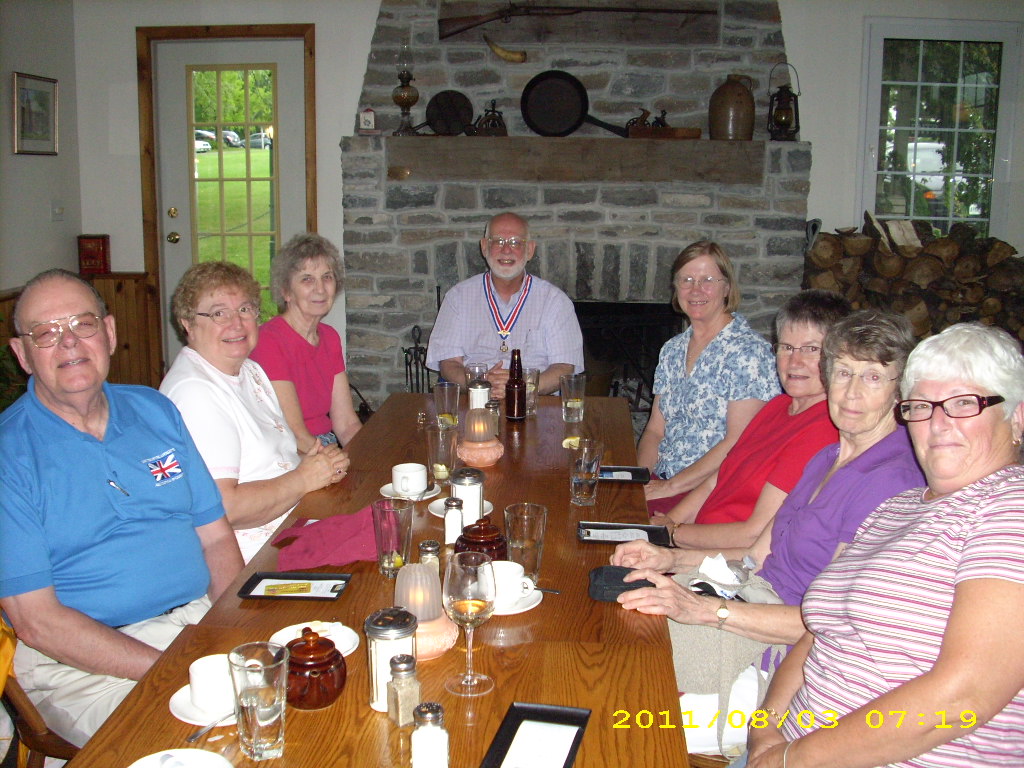
On Wednesday, 03 July 2011, Grietje and I attended the the
annual picnic of the Bay of Quinte Branch. We were joined by seven other
members of the Kawartha Branch, Branch President, Doreen Thompson UE;
Frank Lucas, Branch Sales Chairperson; Joan Lucas UE, Branch Genealogist; their
granddaughter, Emily Lucas UE; Shirley Lowes UE, Branch Treasurer; Elaine
Gillespie UE, Branch Social Convenor; and Pam Dickey UE, Branch Secretary;
attended . (See photo
of group.) Despite the rain, everyone who attended enjoyed each other's
company while Brian Tackaberry UE, Bay of Quinte Branch President, showed his
guests around the United Empire Loyalist Heritage Centre and Park at
Adolphustown. Our sincere thanks to Brian for being a gracious host.
Seizing opportunities to network enriches the
experiences of all. Some members researched ancestors in the Heritage Centre
and met an enthusiastic "new" loyalist from the United States who was
discovering his family's Loyal roots for the first time. His infectious
enthusiasm couldn't help but ignite our willingness to teamwork with him to
find written records of his family in Ontario. Teamwork encourages active
members once again!
Bob McBride, President, UELAC
The Tech Side -- Did You Do A
Backup? -- by Wayne Scott UE
Experts tell us that we should schedule a backup of our computer at least once
a month. Pick a day - the first of the month is easy to remember.
If you would like a more frequent backup, set up a weekly schedule, e.g. Sunday
5PM.
A lot has been written regarding the need to back up our
data. Where would you be if your hard drive suddenly crashed?
A short reminder is in order as to what a backup is. USB
external drives can hold over 2 terabytes of information. This should be
more external storage than you'll need for years to come. If your
computer is running Windows Vista or Windows 7, there is a built in backup
manager, found in the Accessories folder. You can choose where to back up
your data to. Often a backup manager will suggest a full system image be
created initially. After the image is complete, the backup manager will
do incremental backups: that is, backing up only changed or new files.
Sounds easy -- and it is. In addition, a schedule can be set up to have
the computer automatically perform the backup. If your computer does not
have a resident backup manager, a Google search will find many, some of which
are quite good and free. Check out some examples and reviews at
http://download.cnet.com/windows/backup-software/.
If you are
performing a manual backup, note that your system disks that came with your
computer (or are on a small system partition on your hard drive) contain your
operating system and don't need to be backed up. A rule of thumb is to
back up any file that has information that you have created, like program
files, e.g. Family Tree Maker.
That is really all that you need
to know about backups, well, almost. How do you know that the computer is
actually doing the scheduled backup? After all, the schedule was set so
that the backup will be performed when you are away from the computer.
You say that when you have checked, a red or a green light was flashing and a
message appeared on your computer saying that the backup was successful.
How do you know that your external drive is not mal-functioning? The
process is not too difficult.
Under the ‘My Computer' icon in
the start menu is a listing of all the storage devices on your computer.
The backup drive is usually listed on the same line as your ‘C' drive,
sometimes referred to as a ‘Local' drive or disk. If you started with
an empty drive, there will be a notation under the drive icon to tell you how
much space on the drive is used. It the notation says that there is 450
GB free of 450 GB, your backup attempts are failing. Most often the numbers
won't match, indicating that information is being stored.
The
next step would be to go to a folder in your documents. Rename the folder
by adding an ‘A' after the name and save the change. Navigate to the
backup file on the external drive. Navigate to the file that was just
renamed. Restore this file. (Usually you will have to click on the
file or box beside it to select the file. There will be a ‘Restore'
icon -- click on it.) When the file is restored, it will be easy to
compare the renamed file with the restored file. They should be the
same. Now you can be confident that your backup strategy is working on
your computer..
Copies of your Documents, Pictures and
Genealogy files need to be backed up on portable media (i.e. DVD's, flash
drives, portable, or usb hard drives) and stored away from your home.
Don't forget to distribute to family members or close friends. You cannot have
too many backup locations. These backup copies will need updating on a
regular basis also. An adage to remember: It isn't
if your hard drive will crash, it is when it
will. All hard drives have a life, and it cannot be measured, so be
prepared.
You can email Wayne Scott mail4wayne@cogeco.ca to
get in touch with questions or comments.
Query: Looking for Details about the Ship Industry
While doing more research and preparing for future articles,
Stephen Davidson came upon "The Report on American Manuscripts in the Royal
Institution of Great Britain". The manuscripts are the correspondence that
crossed the desk of Sir Guy Carleton as he supervised the evacuation of the
loyalists as well as British and German troops from April to November of
1783.
In the correspondence for August 5, 1783, there is
a reference to a manifest being submitted for loyalists who were "on board
their own ship".(In other words, as opposed to the ships that made up the
spring, summer, and fall evacuation fleets, this one was not funded by the
British government.) This ship is NOT in the UELAC directory. Its name:
Industry. Its destination: Canada. Does anyone out there in
UE land have a written record or an oral tradition that their ancestors came
to Quebec on the Industry? or have any more information about it? We
would like to add more details to the list of ships involved in the evacuation
of New York, in our Migration by
Ship section.
Please respond to the editor
QUERY: Articles for The Toronto Project
The Toronto Project, which is an online museum of the history
of Toronto and its' people, will launch publicly on October 12th at The
Art Gallery of Ontario. Amongst a number of initiatives, The Toronto
Project is creating a wiki history of the city. This will eventually be an
interactive forum open to everyone's contribution. Prior to the public
launch of the wiki history, The Toronto Project is looking for contributions
of some core articles with which to seed the wiki.
We
have been asked to submit stories of our Loyalist ancestors and their
contributions to the city of Toronto and the area around. Please
submit your story to torontouel@bellnet.ca. We will review and edit,
if necessary, and forward them on to the project co-ordinators.
Karen Windover UE, President, Toronto Branch
Last Post:
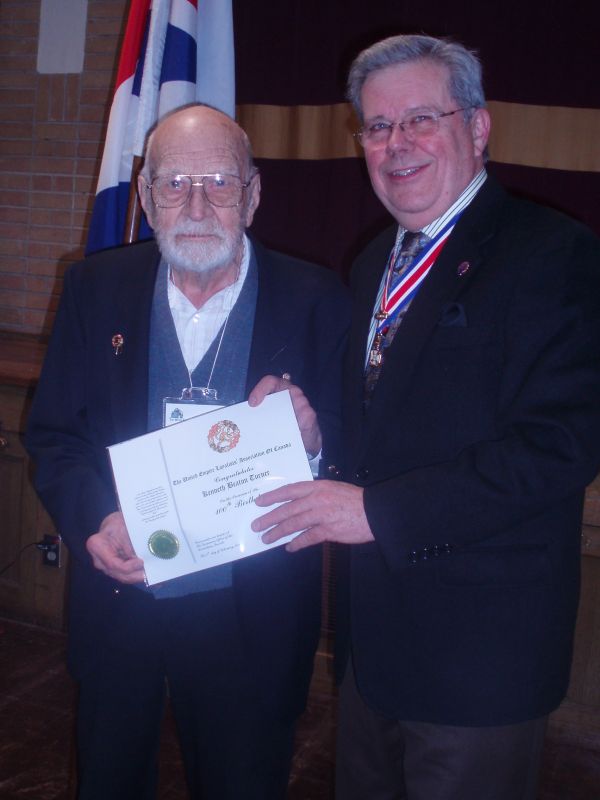
TURNER, Kenneth Beaton CD, UE
Peacefully at the Heritage Green Nursing Home on August 1, 2011, in his
102nd year. Predeceased by his beloved wife Constance Claire Smith in 1993.
Dear father of his daughter Elizabeth Jane (husband Robert Dunn), his son K.
John (wife Nancy), his daughter Mary Constance (husband Michael Murray), his
son David William (wife Trina), and twelve grandchildren and eighteen
great-grandchildren. Survived by his sister Katherine. Predeceased by three
sisters and two brothers.
Ken was a veteran of the
RCAF from 1942 to 1959, retiring with the rank of Squadron Leader, his last
post as Chief Budget Officer in Ottawa. Worked for several trust companies
both before and after the war, including the formation and operation of
Lincoln, Astra and Effort Trust.
Ken was a member
and past president of the Brougham Union Masonic Lodge in Claremont
and the Murton Lodge of Perfection (1961) Hamilton. Ken belonged to the
Rotary Club of Niagara Falls (42 years of perfect attendance, served as
President), the Dundas Rotary Club and the Dundas Valley Sunrise Rotary
Club. which was formed in 1999. He was also a Paul Harris Fellow of
the Rotary Foundation and a Rotary Benefactor. Ken was a former member
of the Scottish Rite, was active in his church activities throughout his
lifetime and also volunteered at McMaster.
In 2003,
Ken received
his Certificate of Loyalist Lineage for James Cowell Turner as a member
of the Hamilton Branch UELAC.
Cremation has taken
place. A memorial service will be held at the Dundas Baptist Church on
Saturday, August 27th at 11 a.m. Donations to the Cancer Assistance Program
or a charity of your choice would be appreciated by the family. www.catteleatonandchambers.ca
--