|
Comtemporary
Clothing
A variety of skin fashions exist within Copper Inuit communities
today (Oakes 1992b, 1994). For example, on Victoria Island,
dog skins are used for clothing, particularly for boots. On
the mainland, wolf leg skins are used, while dog skins are
rarely used. Chemically tanned wild mink, arctic hare, rabbit,
and cowhides, which are readily available from the Winnipeg
Fur Exchange as well as from Northern and Co-op stores, are
made into stylish inner or outer parkas for festivals and
community events. In additon, commercially tanned ringed seal
and short-sheared sheepskin are used for inner and outer boots,
stockings, and slippers. One-of-a-kind items are made from
both home-scraped and commercially tanned skins: skunk mitts,
beaver mitts, otter parkas, polar bear mitts, and polar bear
outer boots. Today, a wide variety of winter fabrics and imitation
furs are available. Imitation mink, rabbit, and cowhide, as
well as brightly coloured fake fur, are made into parkas.
Historical patterns are adjusted to incorperate zippers, pockets,
new fabrics, and new hemlines.
Footwear
For their footwear, Copper Inuit use skins from seal, caribou,
wolverine, wolf, and other animals that live along the treeline
and coast.
They make a wide variety of kamiks, the most notable feature
being a stiff, boatlike Alaskan-style pleated preformed sole
or a flat sole. Pleated soles are made from bleached or shaved
bearded or ringed seal skin.
|
Kamiks with flat soles are commonly worn around town and on
long hunts. Soles of shaved or aged ringed or bearded seal
skin are too stiff for winter use and are preferred for spring
boots. Winter kamiks usually have soles and vamps cut from
commercially smoked moosehide or haired caribou bull skin
(the hair is worn to the inside), vinyl, depilated caribou,
or shaved caribou bull skin. The smoked moosehide and caribou
are brought from commercial outlets or processed at home.
One seamstress from Coppermine visited the Dene in Rae Edzo
to learn the smoke-tanning process (Klengenberg 1985), and
in the early 1970s, Dene women were brought into Coppermine
to teach Inuit their moose-tanning process (Elias 1992). Pleated
and flat soles are used with two types of vamps. One vamp
is cut with a vamp-leg seam that ends in a sharp point at
the centre front; this seam extends up to the ankle area.
The second vamp type, which has a centre front panel that
extends up to the top of the boot, is usually used when the
leg section is cut from leg skins or stroud. From the 1930s
to the 1950s, men wore a kamik with a vamp that encircled
the foot and with a centre back seam at the heel (Joss Collection
1928-50). The upper section consisted of dark and light coloured
vertical panels ot stroud. This style (similar to Type 3Ae
in Webber 1989) is not commonly made today (Oakes 1991a).
|
Leg sections are stovepipe shaped, and boot heights vary from
mid-shin to just below the knee. Canvas, stroud, vinyl, and
other fabrics, as well as haired ringed seal skin, sheepskin
and the leg skins of caribou, wolf, and dog, are used for
leg sections. Caribou leg skin boots are decorated with purchased
trim, a broad band of fabric, or cut-out seal skin. The height
and coloration varies depending on the availability of Peary's
caribou leg skins and personal preferences. Ankle straps (about
4 to 8 mm wide) are a common feature on Copper Inuit kamiks.
They are sewn directly to each side near the back of the heel
or are threaded through a system of loops sewn to the boot.
In the past, footwear was also used for other purposes. For
example, a single kamik was used as a bag to hold the bones
and sinew or rope needed to play a traditional bone game.
This game is played in a variety of ways. One method is to
tie a noose at one end of the length of sinew or rope. All
the bones are placed inside the boot and the drawstring is
pulled as tight as possible. The player slips the noose inside
the boot and attempts to snare a bone. When it feels like
there might be a bone in the noose, the player pulls the noose
tight and carefully draws it out through the small opening
at the top of the boot.
Street
Hockey
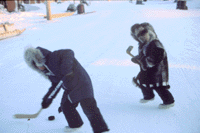
Almost every northern community has an ice rink
or pond on which to play hockey. In addition, it is common
to see groups of children playing impromptu games of street
hockey, wearing skin boots and southern-style winter clothing.
The skin boots provide warm insulation, enabling the young
athletes to play outside for extended periods of time.
|